 Add to Chrome
 Add to Firefox
 Add to Edge
Dr. SHAP-AV: Decoding Relative Modality Contributions via Shapley Attribution in Audio-Visual Speech Recognition
Mar 12, 2026
Audio-Visual Speech Recognition (AVSR) leverages both acoustic and visual information for robust recognition under noise. However, how models balance these modalities remains unclear. We present Dr. SHAP-AV, a framework using Shapley values to analyze modality contributions in AVSR. Through experiments on six models across two benchmarks and varying SNR levels, we introduce three analyses: Global SHAP for overall modality balance, Generative SHAP for contribution dynamics during decoding, and Temporal Alignment SHAP for input-output correspondence. Our findings reveal that models shift toward visual reliance under noise yet maintain high audio contributions even under severe degradation. Modality balance evolves during generation, temporal alignment holds under noise, and SNR is the dominant factor driving modality weighting. These findings expose a persistent audio bias, motivating ad-hoc modality-weighting mechanisms and Shapley-based attribution as a standard AVSR diagnostic.

FlashLips: 100-FPS Mask-Free Latent Lip-Sync using Reconstruction Instead of Diffusion or GANs
Dec 23, 2025We present FlashLips, a two-stage, mask-free lip-sync system that decouples lips control from rendering and achieves real-time performance running at over 100 FPS on a single GPU, while matching the visual quality of larger state-of-the-art models. Stage 1 is a compact, one-step latent-space editor that reconstructs an image using a reference identity, a masked target frame, and a low-dimensional lips-pose vector, trained purely with reconstruction losses - no GANs or diffusion. To remove explicit masks at inference, we use self-supervision: we generate mouth-altered variants of the target image, that serve as pseudo ground truth for fine-tuning, teaching the network to localize edits to the lips while preserving the rest. Stage 2 is an audio-to-pose transformer trained with a flow-matching objective to predict lips-poses vectors from speech. Together, these stages form a simple and stable pipeline that combines deterministic reconstruction with robust audio control, delivering high perceptual quality and faster-than-real-time speed.
Omni-AVSR: Towards Unified Multimodal Speech Recognition with Large Language Models
Nov 10, 2025Large language models (LLMs) have recently achieved impressive results in speech recognition across multiple modalities, including Auditory Speech Recognition (ASR), Visual Speech Recognition (VSR), and Audio-Visual Speech Recognition (AVSR). Despite this progress, current LLM-based approaches typically address each task independently, training separate models that raise computational and deployment resource use while missing potential cross-task synergies. They also rely on fixed-rate token compression, which restricts flexibility in balancing accuracy with efficiency. These limitations highlight the need for a unified framework that can support ASR, VSR, and AVSR while enabling elastic inference. To this end, we present Omni-AVSR, a unified audio-visual LLM that combines efficient multi-granularity training with parameter-efficient adaptation. Specifically, we adapt the matryoshka representation learning paradigm to efficiently train across multiple audio and visual granularities, reducing its inherent training resource use. Furthermore, we explore three LoRA-based strategies for adapting the backbone LLM, balancing shared and task-specific specialization. Experiments on LRS2 and LRS3 show that Omni-AVSR achieves comparable or superior accuracy to state-of-the-art baselines while training a single model at substantially lower training and deployment resource use. The model also remains robust under acoustic noise, and we analyze its scaling behavior as LLM size increases, providing insights into the trade-off between performance and efficiency.
Mitigating Attention Sinks and Massive Activations in Audio-Visual Speech Recognition with LLMS
Oct 26, 2025Large language models (LLMs) have recently advanced auditory speech recognition (ASR), visual speech recognition (VSR), and audio-visual speech recognition (AVSR). However, understanding of their internal dynamics under fine-tuning remains limited. In natural language processing, recent work has revealed attention sinks, tokens that attract disproportionately high attention, and associated massive activations in which some features of sink tokens exhibit huge activation in LLMs. In this work, we are the first to study these phenomena in multimodal speech recognition. Through a detailed analysis of audio-visual LLMs, we identify attention sinks and massive activations not only at the BOS token but also at intermediate low-semantic tokens across ASR, VSR, and AVSR. We show that massive activations originate in the MLP layers and correspond to fixed feature indices across all sink tokens. We further show that intermediate sink tokens exhibit high cosine similarity to the BOS token, thereby amplifying attention and activation. Building on these insights, we introduce a simple decorrelation loss that reduces cosine similarity between BOS and other tokens, effectively mitigating intermediate sinks and massive activations. Furthermore, our method improves word error rate (WER) under high audio-visual feature downsampling while remaining stable at lower downsampling rates.
Revival with Voice: Multi-modal Controllable Text-to-Speech Synthesis
May 25, 2025This paper explores multi-modal controllable Text-to-Speech Synthesis (TTS) where the voice can be generated from face image, and the characteristics of output speech (e.g., pace, noise level, distance, tone, place) can be controllable with natural text description. Specifically, we aim to mitigate the following three challenges in face-driven TTS systems. 1) To overcome the limited audio quality of audio-visual speech corpora, we propose a training method that additionally utilizes high-quality audio-only speech corpora. 2) To generate voices not only from real human faces but also from artistic portraits, we propose augmenting the input face image with stylization. 3) To consider one-to-many possibilities in face-to-voice mapping and ensure consistent voice generation at the same time, we propose to first employ sampling-based decoding and then use prompting with generated speech samples. Experimental results validate the proposed model's effectiveness in face-driven voice synthesis.
FaceCrafter: Identity-Conditional Diffusion with Disentangled Control over Facial Pose, Expression, and Emotion
May 21, 2025Human facial images encode a rich spectrum of information, encompassing both stable identity-related traits and mutable attributes such as pose, expression, and emotion. While recent advances in image generation have enabled high-quality identity-conditional face synthesis, precise control over non-identity attributes remains challenging, and disentangling identity from these mutable factors is particularly difficult. To address these limitations, we propose a novel identity-conditional diffusion model that introduces two lightweight control modules designed to independently manipulate facial pose, expression, and emotion without compromising identity preservation. These modules are embedded within the cross-attention layers of the base diffusion model, enabling precise attribute control with minimal parameter overhead. Furthermore, our tailored training strategy, which leverages cross-attention between the identity feature and each non-identity control feature, encourages identity features to remain orthogonal to control signals, enhancing controllability and diversity. Quantitative and qualitative evaluations, along with perceptual user studies, demonstrate that our method surpasses existing approaches in terms of control accuracy over pose, expression, and emotion, while also improving generative diversity under identity-only conditioning.
KeySync: A Robust Approach for Leakage-free Lip Synchronization in High Resolution
May 01, 2025Lip synchronization, known as the task of aligning lip movements in an existing video with new input audio, is typically framed as a simpler variant of audio-driven facial animation. However, as well as suffering from the usual issues in talking head generation (e.g., temporal consistency), lip synchronization presents significant new challenges such as expression leakage from the input video and facial occlusions, which can severely impact real-world applications like automated dubbing, but are often neglected in existing works. To address these shortcomings, we present KeySync, a two-stage framework that succeeds in solving the issue of temporal consistency, while also incorporating solutions for leakage and occlusions using a carefully designed masking strategy. We show that KeySync achieves state-of-the-art results in lip reconstruction and cross-synchronization, improving visual quality and reducing expression leakage according to LipLeak, our novel leakage metric. Furthermore, we demonstrate the effectiveness of our new masking approach in handling occlusions and validate our architectural choices through several ablation studies. Code and model weights can be found at https://antonibigata.github.io/KeySync.
Contextual Speech Extraction: Leveraging Textual History as an Implicit Cue for Target Speech Extraction
Mar 11, 2025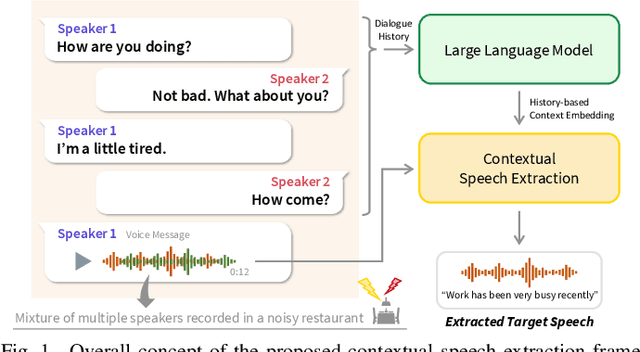
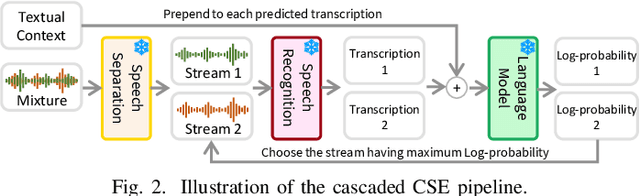
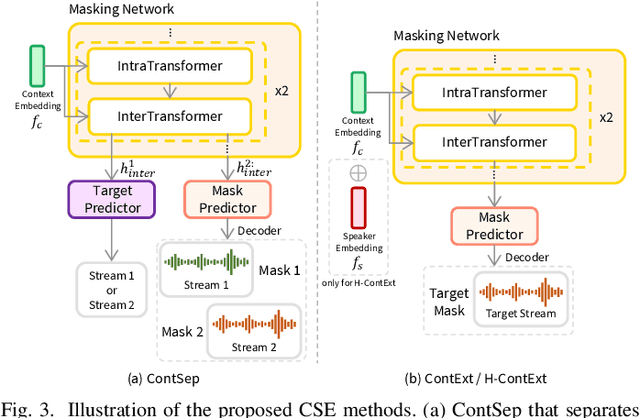
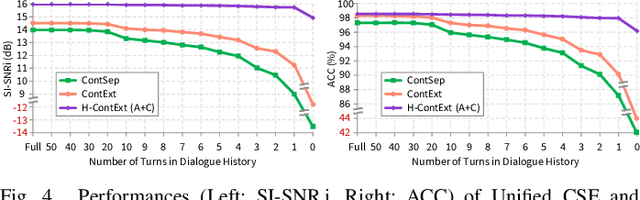
In this paper, we investigate a novel approach for Target Speech Extraction (TSE), which relies solely on textual context to extract the target speech. We refer to this task as Contextual Speech Extraction (CSE). Unlike traditional TSE methods that rely on pre-recorded enrollment utterances, video of the target speaker's face, spatial information, or other explicit cues to identify the target stream, our proposed method requires only a few turns of previous dialogue (or monologue) history. This approach is naturally feasible in mobile messaging environments where voice recordings are typically preceded by textual dialogue that can be leveraged implicitly. We present three CSE models and analyze their performances on three datasets. Through our experiments, we demonstrate that even when the model relies purely on dialogue history, it can achieve over 90 % accuracy in identifying the correct target stream with only two previous dialogue turns. Furthermore, we show that by leveraging both textual context and enrollment utterances as cues during training, we further enhance our model's flexibility and effectiveness, allowing us to use either cue during inference, or combine both for improved performance. Samples and code available on https://miraodasilva.github.io/cse-project-page .
KeyFace: Expressive Audio-Driven Facial Animation for Long Sequences via KeyFrame Interpolation
Mar 03, 2025Current audio-driven facial animation methods achieve impressive results for short videos but suffer from error accumulation and identity drift when extended to longer durations. Existing methods attempt to mitigate this through external spatial control, increasing long-term consistency but compromising the naturalness of motion. We propose KeyFace, a novel two-stage diffusion-based framework, to address these issues. In the first stage, keyframes are generated at a low frame rate, conditioned on audio input and an identity frame, to capture essential facial expressions and movements over extended periods of time. In the second stage, an interpolation model fills in the gaps between keyframes, ensuring smooth transitions and temporal coherence. To further enhance realism, we incorporate continuous emotion representations and handle a wide range of non-speech vocalizations (NSVs), such as laughter and sighs. We also introduce two new evaluation metrics for assessing lip synchronization and NSV generation. Experimental results show that KeyFace outperforms state-of-the-art methods in generating natural, coherent facial animations over extended durations, successfully encompassing NSVs and continuous emotions.
Unified Speech Recognition: A Single Model for Auditory, Visual, and Audiovisual Inputs
Nov 04, 2024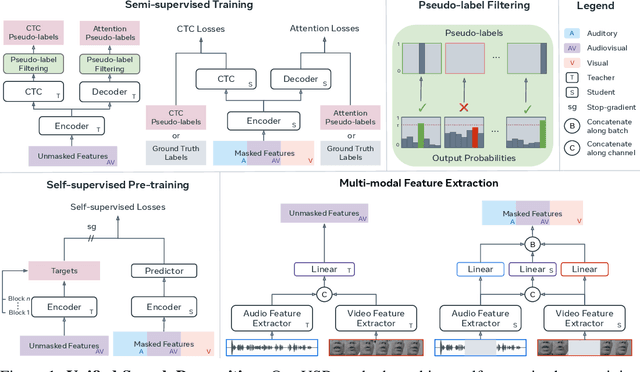
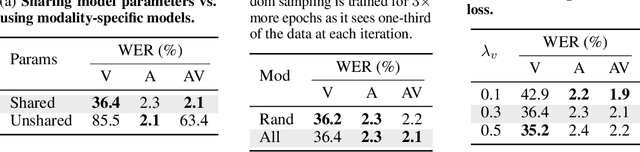
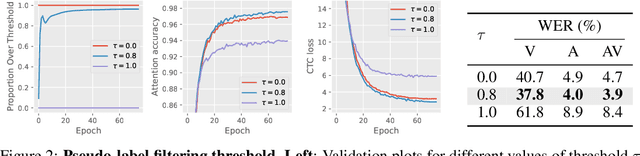
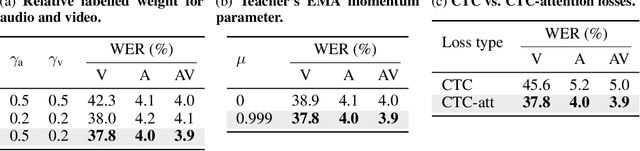
Research in auditory, visual, and audiovisual speech recognition (ASR, VSR, and AVSR, respectively) has traditionally been conducted independently. Even recent self-supervised studies addressing two or all three tasks simultaneously tend to yield separate models, leading to disjoint inference pipelines with increased memory requirements and redundancies. This paper proposes unified training strategies for these systems. We demonstrate that training a single model for all three tasks enhances VSR and AVSR performance, overcoming typical optimisation challenges when training from scratch. Moreover, we introduce a greedy pseudo-labelling approach to more effectively leverage unlabelled samples, addressing shortcomings in related self-supervised methods. Finally, we develop a self-supervised pre-training method within our framework, proving its effectiveness alongside our semi-supervised approach. Despite using a single model for all tasks, our unified approach achieves state-of-the-art performance compared to recent methods on LRS3 and LRS2 for ASR, VSR, and AVSR, as well as on the newly released WildVSR dataset. Code and models are available at https://github.com/ahaliassos/usr.